
The Tarot de Marseille Cross Spread: A Step-by-Step Method
Situation, challenge, advice, influences, synthesis: how to lay out and read a Tarot de Marseille cross spread, with the 5 positions and a full example.
1st reading free · pay as you go
Contents(10 sections)
- What is the cross spread in the Tarot de Marseille?
- What are the 5 positions of the cross spread?
- How do you phrase your question for a cross spread?
- How do you do a cross spread, step by step?
- What does a complete cross spread look like?
- How do you read the links between the cards of the cross?
- What are the best practices for a successful cross spread?
- Cross spread or three-card spread: which one should you choose?
- What the cross spread brings you
- Frequently asked questions
The Tarot de Marseille cross spread uses five cards laid out in a cross: the situation on the left, the challenge on the right, the advice at the top, the influences at the bottom and the synthesis in the centre. You draw them face down, read each one in its place, then the links between them, and close with one sentence that answers your question.
Key points
- Five positions, set before you draw: Situation, Challenge, Advice, Influences, Synthesis.
- In our convention, the centre card is drawn, fifth; a classic variant calculates it by adding up the numbers of the other four.
- The cross suits open questions and situations with several sides.
- The reading happens in three stages: each card in its place, the links, then a one-sentence synthesis.
- The spread sheds light on your present situation; your choices stay in your hands.
What is the cross spread in the Tarot de Marseille?
The cross spread is one of the great classics of the Tarot de Marseille. It was popularised in France in the early twentieth century by the Swiss occultist Oswald Wirth, who describes it in Le Tarot des imagiers du Moyen Âge (1927). Its shape speaks for itself: a horizontal axis for what is at stake, a vertical axis for what guides and what surrounds, and a heart where everything meets.
That is what makes it so useful. With five cards, you get an overview: where you stand, what is testing you, the attitude that helps you, the forces colouring the situation and the message that ties it all together. The spread stays short enough for a clear reading, and rich enough to shed light on a complex question.
What are the 5 positions of the cross spread?
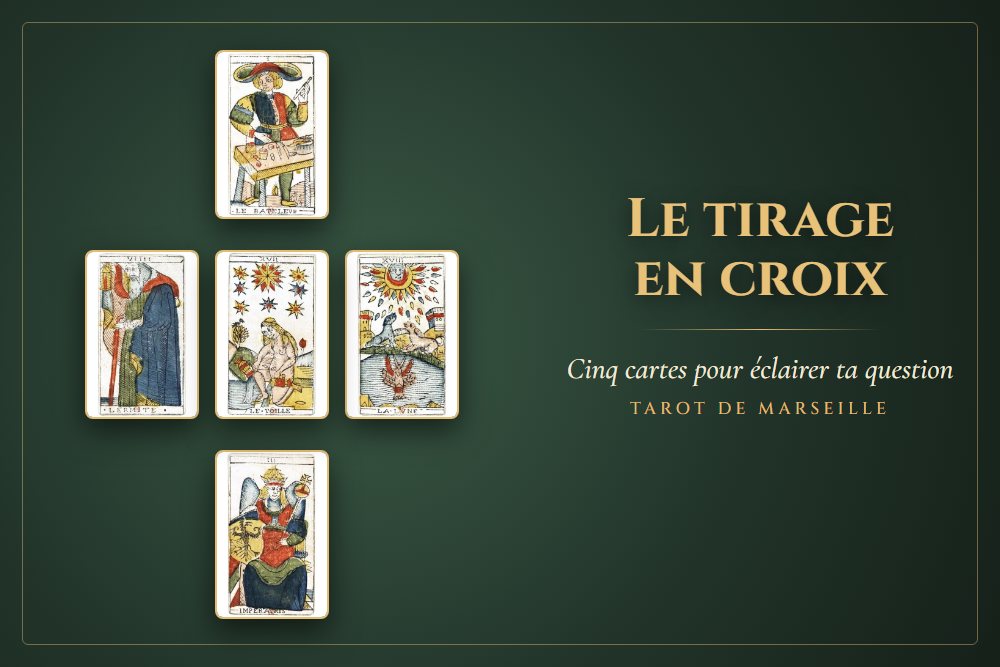
Here is the layout we use, the one in our reading tool The Grand Cross. The numbers show the order in which you lay down the cards.
Each position gives a role to the card that lands there. The same card takes on a different shade depending on its place: The Hanged Man in “Challenge” can describe a wait you are enduring; in “Advice”, it invites you to change your point of view.
| Position | The question it asks | Example |
|---|---|---|
| 1. Situation (left) | What is the heart of the situation, as it stands? | The Hermit: you move forward on your own, with care. |
| 2. Challenge (right) | What test invites me to grow? | The Moon: taming doubt and haziness. |
| 3. Advice (top) | What attitude helps me move forward? | The Magician: start with what you have. |
| 4. Influences (bottom) | What forces around me colour the situation? | The Empress: creative people around you, a fertile energy. |
| 5. Synthesis (centre) | What message brings the whole spread together? | The Star: trust regained. |
Our convention
Tarot de Marseille readers use several versions of the cross. The most common one in books, inherited from Oswald Wirth, draws four cards and calculates the fifth: you add up the numbers of the four arcana, then reduce the total to a number from 1 to 22 (22 standing for The Fool). With a total of 31, for example, you do 3 + 1 = 4, and the synthesis is The Emperor. In that version the positions also carry other names, often “for”, “against”, “judgement” and “solution”.
Our convention comes down to three points. All five cards are drawn, the synthesis included, in fifth and last position. The positions are called Situation, Challenge, Advice, Influences and Synthesis, and are laid out in this order: left, right, top, bottom, centre. Finally, the centre card is read last, as the message that connects the other four. This is exactly the layout of our online tool. Whichever version you choose, keep it from one spread to the next: that is what makes your readings consistent.
How do you phrase your question for a cross spread?
The cross responds best to open questions, the ones that begin with “how”, “what” or “where do I stand”: “How can I give my business fresh momentum?”, “What would help me go through this move more calmly?”. These phrasings leave each position room to answer.
Three guidelines help you phrase it well:
- Centre the question on yourself and on what you can do. “How am I experiencing this relationship?” gives a clear reading and puts you back in charge.
- Choose a single topic per spread: a project, a relationship, a decision.
- Set a time frame if it helps: “over the next three months”, “this year”.
For a yes-or-no answer, a shorter spread will suit you better. Our article on how to ask a good tarot question offers more examples of rephrasing.
How do you do a cross spread, step by step?
- Write down your question. Note it in a notebook, with the date. You can come back to it in a few weeks.
- Choose your deck. The 22 major arcana give a reading focused on the big dynamics; the 78 cards add concrete details.
- Shuffle while thinking about your question. Take your time, until you feel ready.
- Draw five cards face down and lay them out in order: 1 on the left, 2 on the right, 3 at the top, 4 at the bottom, 5 in the centre.
- Turn them over one by one, in the same order. Keep the centre card for last.
- Read each card in its place. Look at the image: is the figure moving forward, waiting, looking left or right? Then ask yourself what the position asks of this card.
- Read the links, then the synthesis, and write one sentence that answers your question.
If you draw online, the principle is the same: the question and the positions are set before the cards appear.
What does a complete cross spread look like?
Here is a typical example, built to illustrate the method: a spread imagined for this article, using the cards of Jean Dodal’s Tarot de Marseille. Question: “How can I give my professional life fresh momentum?”
1. Situation: The Hermit (VIIII)
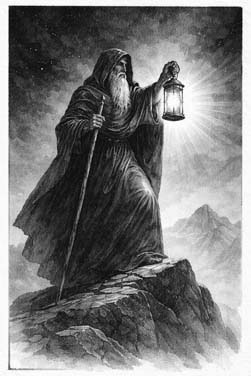
The Hermit walks slowly, leaning on his staff, his lantern raised before him. In the Situation position, he describes a time of withdrawal: you move forward on your own, with care, looking for what feels meaningful to you. This solitude has value: it has let your experience ripen. The lantern shows that you already hold a light, however modest, to illuminate the next step.
2. Challenge: The Moon (XVIII)
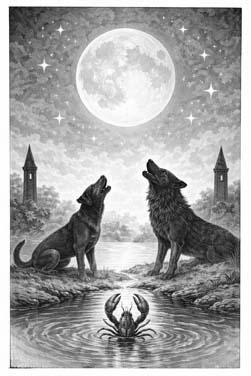
The Moon shows two dogs howling, a crayfish climbing out of a pool and two towers in the distance. In the Challenge position, it points to the test of haziness: doubts, imagined scenarios, fears that surface at night. The challenge is to tame this share of uncertainty, telling apart what you know from what you imagine.
3. Advice: The Magician (I)
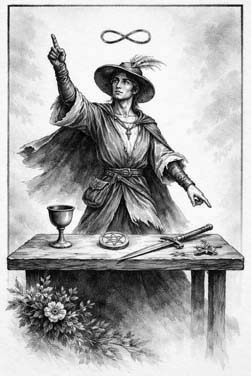
The Magician stands before a table set with cups, dice and a knife, wand in hand. In the Advice position, he invites you to start with what you have: a first step, a simple offer, a contact to follow up. His tools are already on the table. The advice is to pick one and use it this week.
4. Influences: The Empress (III)
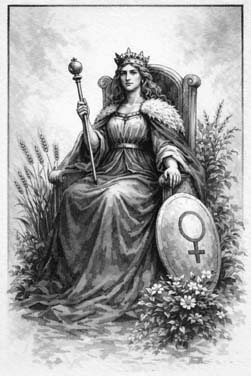
The Empress, winged and crowned, holds her sceptre and her shield bearing the eagle. In the Influences position, she describes a fertile environment: creative people around you, a period that favours self-expression, a network ready to share what you do. These forces are available; it is up to you to connect with them.
5. Synthesis: The Star (XVII)
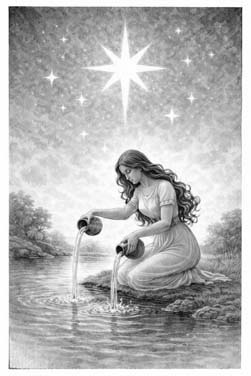
The Star pours out her two jugs beneath a starry sky, a bird perched on the tree behind her. In the centre, she gathers the spread into a message of trust: what you have ripened in withdrawal can now be shared. The water she pours flows generously, like a talent offered to others.
Overall reading. The Hermit and The Magician answer each other: one has searched for a long time, the other takes action. The Moon and The Star share the same night sky: the doubts of the Challenge position find their answer in the light of the synthesis. The Empress, at the bottom, nourishes the whole with her creative energy. Synthesis: “My fresh momentum comes from my experience: I take a first concrete step, I lean on the creative people around me, and my confidence will grow as I go.”
For comparison, the calculated variant would give 9 + 18 + 1 + 3 = 31 here, so 3 + 1 = 4: The Emperor, who would invite you to give this new momentum a structure. The two readings complement each other, and the convention set at the start decides which card you keep.
How do you read the links between the cards of the cross?
The strength of the cross lies in its two axes. Each one forms a pair to read together, before you reach the centre.
- The horizontal axis (Situation and Challenge) describes what is at stake right now. Are the figures looking at each other? Are they turned in the same direction? A Hermit facing The Moon, for example, shows that your gaze is already directed towards what puzzles you.
- The vertical axis (Advice and Influences) describes what helps you: at the top, the attitude to adopt; at the bottom, the forces that carry you. When these two cards point the same way, the path flows; when they differ, they show two complementary resources.
- The centre (Synthesis) is read last, as the meeting point of the two axes. Ask yourself how it answers the Situation and what it brings to the Challenge.
Also watch for repetitions: a colour, a gesture, the same sky or the same water from one card to another. And look at the balance: several major arcana signal a deep-rooted question; several minors, a more everyday situation, with levers you can use right away. Our article on reading two-card combinations explores this step in detail.
What are the best practices for a successful cross spread?
- Set the positions before you draw, and keep them until the end of the reading. That is what gives each card its role.
- Welcome the card that surprises you. It often has the most to say. Ask yourself what it illuminates if it is right.
- Read the Challenge position as an invitation to grow. It points to what you can work on, within you or around you.
- Give the Advice a concrete form: a step to take this week, a conversation to open, an attitude to try.
- Keep the synthesis for last, once you have understood both axes.
- Go deep with one spread per question. One well-read spread gives you more than several skimmed ones. Ask the question again later, once the situation has moved on.
- Write down your synthesis sentence and reread it a few weeks later: you will see what the spread has brought you.
Cross spread or three-card spread: which one should you choose?
The three-card spread is ideal for a precise question: understanding a change (past, present, future) or finding a lever (situation, obstacle, advice). It goes straight to the point and takes a few minutes to read.
The cross spread takes over when the situation has several sides. It adds two valuable perspectives: the influences, which show the forces around you, and the synthesis, which gathers the reading into one message. Choose it for an important project, a period of transition, or a relationship you want to understand as a whole.
A good habit: start with three cards to clarify your question, then move on to the cross when you want to step back and see the whole picture.
What the cross spread brings you
A cross spread sheds light on your present situation. It offers you five images to reflect on, highlights what is testing you and what supports you, and leaves the decision in your hands. The cards describe a tendency; the future stays open, and your choices shape it.
For questions of health, money or law, a reading does not replace the advice of a professional: a doctor, an adviser or a lawyer. Tarot then helps you clarify what you feel before you talk it over with them.
Do you have a question that deserves an overview? Lay out your five cards, read each axis, and let the centre have the final word.
Frequently asked questions
How do you do a Tarot de Marseille cross spread?
Phrase an open question, shuffle the cards while thinking about it, then draw five cards face down. Place the first on the left (situation), the second on the right (challenge), the third at the top (advice), the fourth at the bottom (influences) and the fifth in the centre (synthesis). Read each card in its place, then the links between them, and finish with one sentence that answers your question.
What does the centre card mean in a tarot cross spread?
In our convention, the centre card is the synthesis: the message that brings the whole spread together. You draw it like the other four, in fifth position, and read it last, in the light of the situation, the challenge, the advice and the influences.
Do you add up the cards to find the fifth one?
That is a classic variant, described notably by Oswald Wirth: you add up the numbers of the first four arcana and reduce the total until you reach a major arcanum. In our convention, the fifth card is drawn. Both methods have their own logic; choose one and keep it from one spread to the next.
Can you do a cross spread with the minor arcana?
Yes. With the 22 major arcana, the cross speaks of the big dynamics behind your question. With all 78 cards, the minor arcana add concrete details about daily life, money, relationships or thoughts. For beginners, the majors give a clearer reading.
What is the difference between the cross spread and the three-card spread?
The three-card spread tells a story of change or sets an obstacle against a piece of advice. The cross spread adds two perspectives: the influences around you and a synthesis in the centre. It suits situations with several sides, when you want an overview and a course of action in the same reading.
Sources and further reading
- Oswald Wirth, Le Tarot des imagiers du Moyen Âge (Paris, 1927)
- Jean Dodal, tarot de type Marseille (Lyon, début du XVIIIe siècle)
Want to try it on your own question?
The app interprets your own Tarot de Marseille spread, card by card, based on the question you ask.
Get a free reading1st reading free · then tokens from €4.99, pay as you go