
Tarot de Marseille and Rider-Waite: the 78-Card Correspondence Table
The correspondence table for all 78 cards: French and English names, numbers, Strength and Justice swapped, suits and court cards of both decks.
1st reading free · pay as you go
Contents(7 sections)
- Where the two decks come from, in brief
- Table 1: the 22 major arcana, from the Marseille deck to the Rider-Waite
- The five differences worth knowing
- Table 2: the four suits and the court cards
- Reading a Marseille card when you know the Rider-Waite
- Why Tarot Universel reads with the Tarot de Marseille
- Frequently asked questions
The Tarot de Marseille and the Rider-Waite-Smith both have 78 cards: 22 major arcana and 56 minor arcana in four suits. Every card in one deck has its counterpart in the other. Several majors change name (La Papesse becomes The High Priestess), Strength and Justice swap numbers, and the suits translate word for word.
Key points
- Both decks share the same structure: 22 major arcana, 40 numbered cards from Ace to Ten, and 16 court cards.
- The 22 majors match one to one; seven of them carry a different name, including La Papesse, Le Pape and La Maison Dieu.
- Justice (VIII) and Strength (XI) in the Marseille deck trade places in the 1909 Rider-Waite, following the Golden Dawn: Strength becomes VIII, Justice XI.
- The Marseille numbered cards arrange the suit symbols in ornamental patterns; the Rider-Waite ones show scenes drawn by Pamela Colman Smith.
- Deniers, Coupes, Épées and Bâtons correspond to Pentacles, Cups, Swords and Wands.
This article is a reference table to keep at hand when you move from a Rider-Waite book to a French Marseille deck. If your question is more “which one should I choose?”, our article Marseille Tarot or Rider-Waite compares their histories, their imagery and their ways of reading.
Where the two decks come from, in brief
The Tarot de Marseille is a deck pattern printed from woodblocks and stencil-coloured in France in the 17th and 18th centuries, in Lyon, Paris or Marseille. The Rider-Waite-Smith was published in London in 1909, designed by Arthur Edward Waite and drawn by Pamela Colman Smith, both members of the Hermetic Order of the Golden Dawn. In 1910 Waite added a book, The Pictorial Key to the Tarot, the source of most English card names in use today.
Table 1: the 22 major arcana, from the Marseille deck to the Rider-Waite
Marseille numbers are given as printed on the old decks: IIII for four, VIIII for nine, XIIII for fourteen, XVIIII for nineteen. The Rider-Waite writes IV, IX, XIV and XIX. The English Marseille name is the one used in common English editions; it varies a little from one publisher to another.
| Marseille No. | French name (Marseille) | English name (Marseille) | Rider-Waite name | Rider-Waite No. | What changes |
|---|---|---|---|---|---|
| I | Le Bateleur | The Juggler | The Magician | I | The fairground juggler becomes a magician |
| II | La Papesse | The Popess | The High Priestess | II | The popess becomes a high priestess |
| III | L’Impératrice | The Empress | The Empress | III | Same name |
| IIII | L’Empereur | The Emperor | The Emperor | IV | Same name, number written IV |
| V | Le Pape | The Pope | The Hierophant | V | The pope becomes a hierophant |
| VI | L’Amoureux | The Lover | The Lovers | VI | A young man between two women becomes a couple |
| VII | Le Chariot | The Chariot | The Chariot | VII | Same name |
| VIII | La Justice | Justice | Justice | XI | Number swapped with Strength |
| VIIII | L’Hermite | The Hermit | The Hermit | IX | Same name, number written IX |
| X | La Roue de Fortune | The Wheel of Fortune | Wheel of Fortune | X | Same name |
| XI | La Force | Strength (Force) | Strength | VIII | Number swapped with Justice |
| XII | Le Pendu | The Hanged Man | The Hanged Man | XII | Same name |
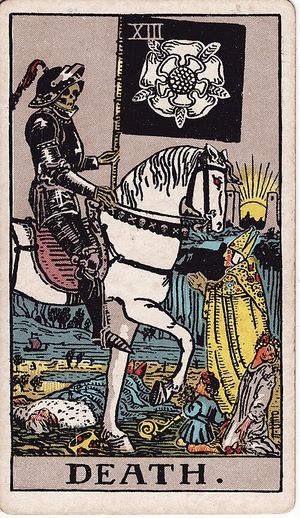
| XIII | L’Arcane sans nom | Death | Death | XIII | In the Marseille deck the card carries its number alone; the Rider-Waite prints DEATH on it |
| XIIII | Tempérance | Temperance | Temperance | XIV | Same name, number written XIV |
| XV | Le Diable | The Devil | The Devil | XV | Same name |
| XVI | La Maison Dieu | The House of God | The Tower | XVI | The house of God becomes the tower |
| XVII | L’Étoile | The Star | The Star | XVII | Same name |
| XVIII | La Lune | The Moon | The Moon | XVIII | Same name |
| XVIIII | Le Soleil | The Sun | The Sun | XIX | Same name, number written XIX |
| XX | Le Jugement | Judgement | Judgement | XX | Same name; Waite calls it “The Last Judgment” in his book |
| XXI | Le Monde | The World | The World | XXI | Same name |
| (unnumbered) | Le Mat | The Fool | The Fool | 0 | Le Mat moves freely through the deck; the Fool carries the zero |
Remember three landmarks: seven name changes (I, II, V, VI, XIII, XVI, and Le Mat turned The Fool), one swap of numbers (VIII and XI), and a different way of writing Roman numerals.
The five differences worth knowing
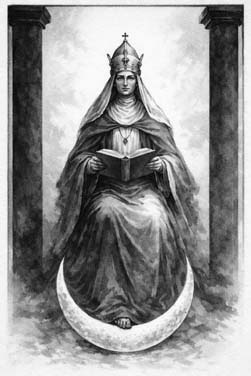
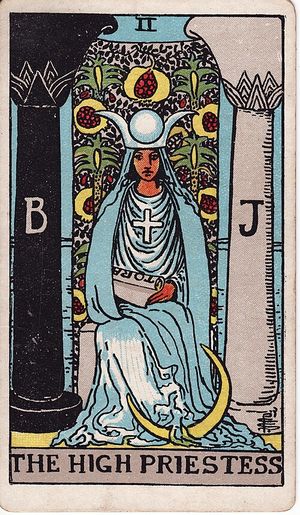
II. La Papesse and The High Priestess
 Tarot de Marseille
La Papesse
 Rider-Waite (1909)
The High Priestess
La Papesse, The Popess, sits before a veil in the Marseille deck, wearing a tiara, an open book on her knees. Waite notes in his book that early commentators called her “Pope Joan”; he prefers to see a priestess of the mysteries in her, hence The High Priestess. On his card she holds a scroll marked TORA, between two pillars. The meaning stays close in both decks: inner knowledge, study, time to mature.
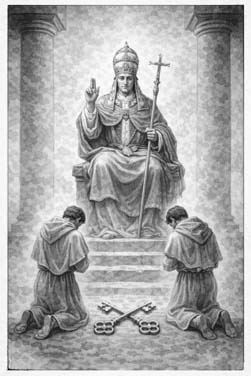
V. Le Pape and The Hierophant
 Tarot de Marseille
Le Pape
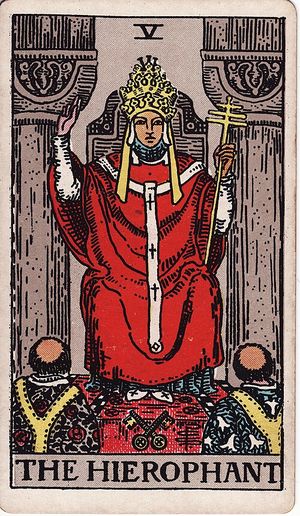 Rider-Waite (1909)
The Hierophant
Le Pape, The Pope, blesses two disciples standing before him. Waite renames the card The Hierophant, after the priest who initiated people into the ancient mysteries, and keeps the scene: a figure of spiritual authority and two kneeling figures. So in an English tarot book, look up “Hierophant” when you hold Le Pape in your hands.
XI. Strength, swapped with Justice
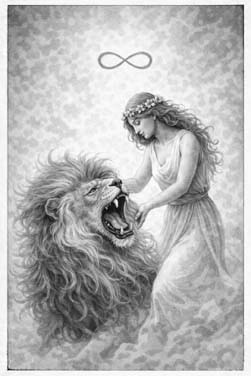 Tarot de Marseille
La Force (XI)
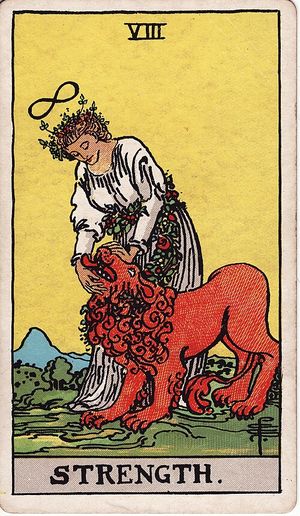 Rider-Waite (1909)
Strength (VIII)
This is the difference that causes the most confusion. In the Marseille deck, Justice carries VIII and Strength XI, as on the decks of the 17th- and 18th-century card makers. In the Rider-Waite, Strength moves to VIII and Justice to XI. Waite says so plainly in The Pictorial Key to the Tarot: “For reasons which satisfy myself, this card has been interchanged with that of Justice, which is usually numbered eight.”
Those reasons come from the Golden Dawn, which linked each major arcanum to a Hebrew letter and an astrological sign. Strength corresponds to Leo, Justice to Libra; in zodiac order, Leo comes before Libra, so Strength moves ahead. Keep the practical rule in mind: an English book that discusses card VIII is describing Strength, your Marseille card XI.
XIII. L’Arcane sans nom and Death
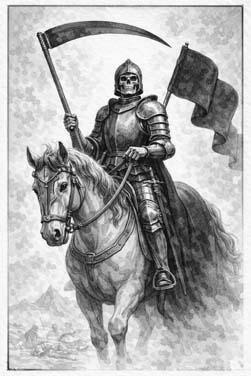 Tarot de Marseille
Arcanum XIII
 Rider-Waite (1909)
Death
On the Jean Dodal deck, as on most early Marseille decks, card XIII shows a skeleton mowing the ground and bears only its number. French tradition therefore calls it L’Arcane sans nom, the Nameless Arcanum. The Rider-Waite prints the title DEATH and draws an armoured rider on a white horse, banner in hand. Both cards speak of an ending that opens a transformation.
XVI. La Maison Dieu and The Tower
 Tarot de Marseille
La Maison Dieu
 Rider-Waite (1909)
The Tower
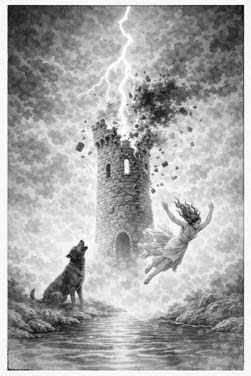
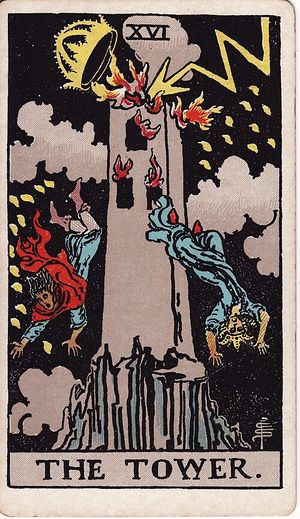
La Maison Dieu, The House of God, shows a tower whose top is struck by a flame, with two figures on the ground. Waite lists several old titles for the card, among them “God’s House” and “Tower of Babel”, and settles on The Tower. The number XVI stays the same. In both decks, the card speaks of a structure renewed in one stroke.
Table 2: the four suits and the court cards
The 56 minor arcana are divided the same way in both decks: in each suit, ten numbered cards from Ace to Ten, then four court cards.
| Suit (Marseille, French) | English name (Marseille) | Suit (Rider-Waite) | What the card shows |
|---|---|---|---|
| Deniers | Coins | Pentacles | Flowered coins in the Marseille deck; discs with a five-pointed star in the Rider-Waite |
| Coupes | Cups | Cups | Ornate cups in both decks |
| Épées | Swords | Swords | Curved, interlaced blades in the Marseille deck, around a straight sword for odd numbers; straight swords in the Rider-Waite |
| Bâtons | Batons or Wands | Wands | Carved, crossed staves in the Marseille deck; leafy branches in the Rider-Waite |
| Court card (Marseille, French) | English name (Marseille) | Court card (Rider-Waite) |
|---|---|---|
| Valet | Page or Knave | Page |
| Cavalier | Knight | Knight |
| Reine | Queen | Queen |
| Roi | King | King |
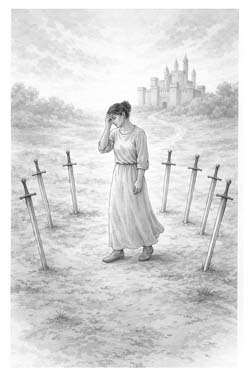
The court cards match in the same order, from Page to King. For the numbered cards, the difference lies in the image: a Marseille Seven of Swords arranges seven blades in a symmetrical pattern, while the Rider-Waite one shows a man walking away from a camp carrying five swords.
The minor arcana show the most visible difference between the two decks: in the Marseille deck, the numbered cards arrange the suit symbols in a pattern; the Rider-Waite turns them into small scenes.
 Tarot de Marseille
Seven of Swords
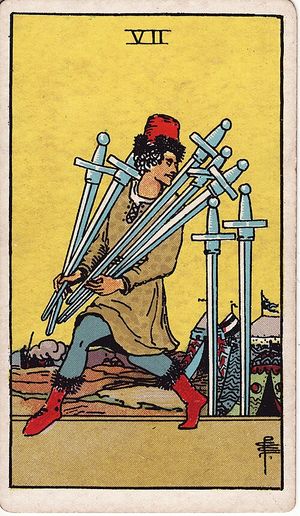 Rider-Waite (1909)
Seven of Swords
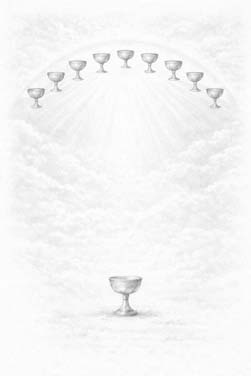 Tarot de Marseille
Ten of Cups
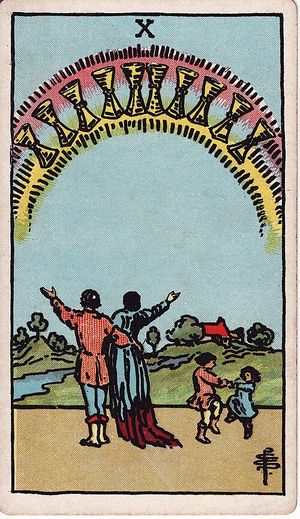 Rider-Waite (1909)
Ten of Cups
Reading a Marseille card when you know the Rider-Waite
You learned tarot with Pamela Colman Smith’s scenes and now hold a Marseille deck? Three habits help you move from one deck to the other.
- For a major arcanum, start from the number and the name. Check Table 1: most meanings carry over directly, as long as you follow the names (The Hierophant for Le Pape) and the VIII/XI swap.
- For a numbered card, read the number and the suit. The Marseille Five of Cups reads as a five, a stage of questioning, in the realm of feelings. The Rider-Waite scene you know gives you a clue; the number and the suit give you the structure.
- Look at the image and the card’s position in the spread. Where is the figure looking? Which neighbouring card echoes a colour or a gesture? The Marseille deck is read largely through these links between cards, which we explain in our method for reading a two-card combination.
With these landmarks, an English tarot book becomes a useful resource for your Marseille deck: you translate the name, adjust the number, and keep your eyes on the image in front of you.
Why Tarot Universel reads with the Tarot de Marseille
Our cards reproduce the Tarot de Marseille by Jean Dodal, engraved in Lyon in the early 18th century (around 1701-1715) and now in the public domain. Its images are the ones you see on the card pages and during your readings. We chose this deck for the richness of its tradition, handed down by generations of card makers and then of readers. The whole app is built around it: its names, its numbering, with Justice at VIII, Strength at XI and Le Mat as the free card, and its four suits guide every interpretation.
Frequently asked questions
What is La Papesse called in English?
In English editions of the Tarot de Marseille, La Papesse is called The Popess. In the Rider-Waite-Smith, the same card II becomes The High Priestess. Both names refer to the second major arcanum: a seated, crowned woman who holds a book in the Marseille deck and a scroll marked TORA in the Rider-Waite.
Why is Strength card XI in the Tarot de Marseille?
The Tarot de Marseille follows the old order of the card makers: Justice at VIII, Strength (La Force) at XI. In 1909 Arthur Edward Waite swapped the two cards in his deck; in The Pictorial Key to the Tarot he writes: "For reasons which satisfy myself, this card has been interchanged with that of Justice, which is usually numbered eight." The usual explanation lies in the astrological correspondences of the Golden Dawn: Leo for Strength, Libra for Justice, in zodiac order.
What is The Pope called in the Rider-Waite tarot?
The Hierophant. The card keeps the number V. English editions of the Tarot de Marseille simply call it The Pope, from the French Le Pape. In both decks, the figure blesses two people standing before him.
What do Coins correspond to in the Rider-Waite tarot?
To Pentacles: discs marked with a five-pointed star. The French name of the Marseille suit is Deniers, usually translated as Coins in English editions. The other suits match word for word: Coupes and Cups, Épées and Swords, Bâtons and Wands.
What is the Rider-Waite equivalent of La Maison Dieu?
The Tower, with the same number XVI. English editions of the Tarot de Marseille often keep a translation of the original name: The House of God. In both decks, lightning strikes the top of a tower and two figures fall.
Sources and further reading
- Tarot Rider-Waite, édition originale de 1909 (Pamela Colman Smith), domaine public — Wikimedia Commons
- Arthur Edward Waite, The Pictorial Key to the Tarot (Londres, Rider, 1910)
- Wikimedia Commons, Tarot de Marseille de Jean Dodal (Lyon, vers 1701)
- Michael Dummett, The Game of Tarot (Londres, Duckworth, 1980)
Want to try it on your own question?
The app interprets your own Tarot de Marseille spread, card by card, based on the question you ask.
Get a free reading1st reading free · then tokens from €4.99, pay as you go