Have you ever felt that singular thrill holding a deck of cards whose symbols seem to whisper forgotten truths? Learning how to draw Tarot cards isn't just an act of curiosity; it's an open door to self-knowledge and understanding the invisible forces that shape our daily lives. In this complete guide, we'll explore the ancestral art of the Tarot de Marseille together to transform your intuition into a powerful tool for guidance. You'll discover the precise methods, preparation rituals, and specific spreads that make Tarot Universel famous.
What you'll learn in this article: the fundamental basics of card manipulation, the necessary mental preparation before each session, and above all, the six essential drawing methods: from the simple card of the day to the complexity of the Great Cross. Whether you're a complete novice or looking to deepen your practice, this journey into the heart of the Arcana will give you the keys to read the future with clarity and benevolence.
Prerequisites: Before asking your first question
Even before trying to learn how to draw Tarot cards, it's crucial to understand that the Tarot is a mirror. It doesn't predict a destiny set in stone, but reveals the energies in motion. For this mirror to be clear, adequate preparation is essential. Imagine trying to listen to a subtle melody in a noisy train station; it's impossible. The same goes for the Tarot: calm is your best ally.
The environment and state of mind
Create a dedicated space. It's not necessary to have a complex altar, but a clean table, soft light, and perhaps a candle are enough to signal to your subconscious that you're entering a sacred space. Your inner state is just as important. Never draw cards if you're in a dark rage or extreme distress. Strong emotion acts as a distorting filter on interpretation. Take three deep breaths, anchor your feet to the ground, and clear your mind.
Pro tip: If you feel too emotionally involved in a question, ask a third party to draw for you or wait for calm to return. Neutrality is the key to accuracy.
Chapter 1: Choosing and consecrating your Tarot de Marseille
At Tarot Universel, we favor the Tarot de Marseille for its pure archetypal structure. Its images, inherited from centuries of tradition, speak directly to the collective unconscious. For a beginner, choosing their first deck is a strong symbolic step. You're not just choosing a tool, but a travel companion. If you hesitate about the initial investment, you can consult ourrates to discover our support offers, which often include deck recommendations.
The connection with the cards
Once you've acquired your deck, take the time to 'consecrate' it. This may seem mystical, but it's simply about charging the cards with your own energy. Handle them, look at each arcana one by one, sleep with the deck under your pillow if you wish. The goal is for the deck to become an extension of your hand. The more familiar you are with the graphics of the cards (the colors, the characters' expressions, the objects they hold), the more fluid the interpretation will become.
- Check that your deck contains all 22 Major Arcana.
- Observe the dominant colors: blue for spirituality, red for action, yellow for intelligence.
- Always store your deck in a silk or velvet pouch to protect it from external energies.
Chapter 2: How to draw Tarot cards? The step-by-step method
The technical process for knowing how to draw Tarot cards is a choreography that requires concentration. It's not just a simple shuffle of playing cards. Each gesture counts to establish a connection between your question and the symbols.
Shuffling and cutting
Start by shuffling the cards. There's no strict rule on how to shuffle, the important thing is that you do it while thinking intensely about your question. Avoid closed questions that call for a simple yes or no if you're looking for a deep analysis, prefer formulations like 'What is the energy surrounding me currently?' or 'How can I improve my professional situation?'.
Once shuffled, place the deck face down and cut it with your left hand (the hand of the heart and intuition). Observe the two cards appearing at the cut: they often give the general 'tone' of the draw or the consultant's hidden state of mind. Then, spread the cards in a fan in front of you, always face down.
Warning: Never ask the same question twice in a row because you don't like the answer. The Tarot has already spoken; insisting would only blur future messages.
Chapter 3: Quick draws for everyday life
To learn how to draw Tarot cards effectively, nothing beats regular practice. Quick draws are perfect for building your intuition without getting lost in interpretations that are too complex at the beginning.
The Card of the Day
This is the quintessential morning exercise. Draw a single card each morning. Don't try to guess if you're going to win the lottery, but ask: 'What lesson should I integrate today?'. If you draw the Arcane without Name, it may mean a day of great cleansing or transition. If it's The Sun, expect clarity and success. Note this card and, in the evening, take stock of your day to see how the energy of the arcana has manifested concretely.
The Yes or No Draw
Although we prefer nuanced answers, the 'Yes/No' draw is useful for quick decisions. Draw three cards. If the majority are positive (The Pope, The Empress, The World), the answer tends towards yes. If it's negative (The Tower, The Moon, The Devil), it's a no or a 'not now'. For more details on the specific meaning of each arcana in this context, don't hesitate to consult ourFAQ.
Chapter 4: The Past, Present, Future Draw
This is undoubtedly the most famous method for understanding the evolution of a situation. This linear draw allows you to see where you come from, where you are, and where you tend to go if nothing changes in your current behavior.
Structure and interpretation
Place three cards from left to right: 1. The Past: The foundations of the situation, the past events that still influence today. 2. The Present: The current state, the forces at play, what you are experiencing here and now. 3. The Future: The most probable outcome if you continue on your current path.
Imagine a typical scenario: a person is wondering about their career change. If the past shows The Wheel of Fortune, it indicates a change that has already been initiated by fate. If the present is The Hermit, the person is currently in a phase of solitary reflection and caution. If the future reveals The Chariot, success and mastery of the new project are assured. The draw tells a coherent story of movement, pause, then victory.
Chapter 5: The Heart & The Soul (Exploring relationships)
The sentimental domain is the number one reason for consultations. How to draw Tarot cards to explore a relationship without falling into fantasy? The 'The Heart & The Soul' method is designed to probe the depths of feelings and the future of a bond.
Card positions
This draw uses four cards arranged in a diamond: - Top (The Soul): The spiritual aspirations of the couple, the higher purpose of the meeting. - Left (The Consultant): What you feel, your position in the bond. - Right (The Other): The feelings and intentions of the other person (often the most revealing area). - Bottom (The Heart): The emotional anchoring and the near future of the relationship.
This draw allows you to identify discrepancies. If your card is The Devil (devouring passion) and the other person's is Temperance (need for calm and communication), the draw immediately points to an asymmetry of needs that explains the possible tensions.
Chapter 6: The Path of Decision
Hesitating between two choices is a universal human situation. Should you accept this new position or stay in your current company? Should you move or wait? The Tarot is an exceptional decision-making tool.
Analyzing the consequences
For this draw, choose a central card that represents the issue. Then, draw two cards for Choice A (at the top) and two cards for Choice B (at the bottom). Compare the energies. The Tarot will not tell you 'Do this', but it will show you 'If you do A, here's the atmosphere; if you do B, here are the challenges'.
- Identify potential blockages for each option.
- Observe which option resonates most with your long-term life project.
- See if a major card appears: it indicates a choice that will have important karmic or structural consequences.
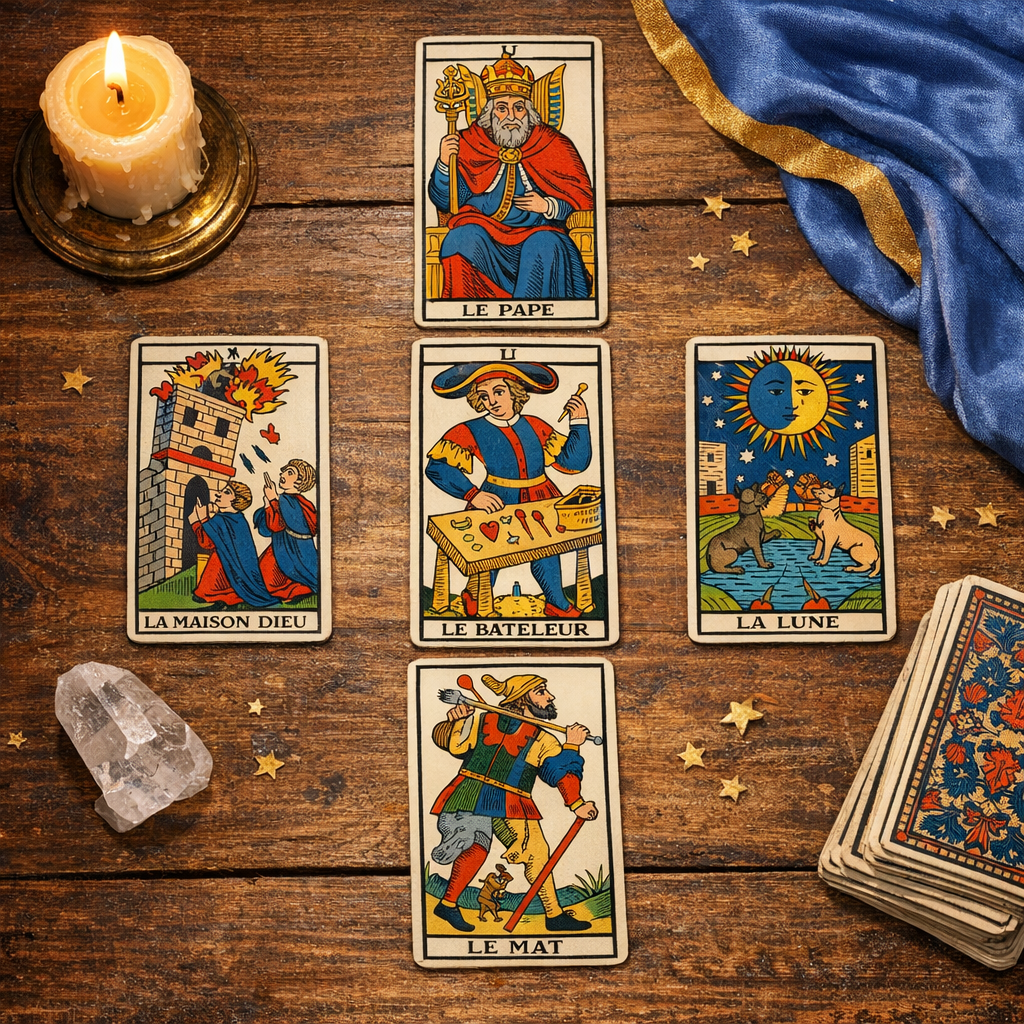
Chapter 7: The Great Cross (In-depth analysis)
The Great Cross is the reference draw at Tarot Universel for a complete analysis of a complex situation. This is where knowing how to draw Tarot cards takes on its full strategic and divinatory dimension.
The deployment of the 5 cards
1. On the left (What helps): Your strengths, your allies, the favorable forces. 2. On the right (What hinders): The obstacles, your fears, the hidden enemies or the delays. 3. At the top (The direction): What dominates the situation, the celestial influence or the objective to be reached. 4. At the bottom (The outcome): The concrete conclusion, the final result. 5. In the center (The Synthesis): The advice of the Tarot, the key to harmonizing the other four forces.
The strength of the Great Cross lies in the interaction between opposites (Left/Right and Top/Bottom). A positive outcome at the bottom can be nuanced by major obstacles on the right, suggesting that success is possible but will require considerable effort. For any complex question, we recommend that youcontact us for a personalized interpretation if the symbols seem contradictory.
Chapter 8: Interpreting the Major Arcana accurately
It's not enough to know how to draw Tarot cards physically, you have to know how to 'read'. Each major arcana of the Tarot de Marseille is a reservoir of meanings. The Magician (I) represents the beginning, the potential, while The World (XXI) represents the culmination and fulfillment.
The levels of reading
A common mistake is to stick to a definition learned by heart. The Tarot is alive. The same card, The Tower, can mean a catastrophe (collapse) or a liberating release (we break down the walls that imprison us). It all depends on the context of the question and the surrounding cards. Learn to look where the characters are looking. If the character on a card is looking towards the card on the left, he is turned towards the past.
Tip: Practice 'arcane meditation'. Take a card, stare at it for 5 minutes and let the details speak to you without consulting a book. Your intuition is your most faithful dictionary.
Chapter 9: Avoiding classic beginner mistakes
Even with the best will, learning how to draw Tarot cards involves pitfalls. The first is wanting to see what you want to see (confirmation bias). If you desperately hope for the return of an ex, you might interpret The Hanged Man as a loving wait when it means a total blockage.
Regularity rather than quantity
Don't draw cards ten times a day. Repetition empties the symbols of their substance. Respect the game. Similarly, avoid drawing cards for trivialities. The Tarot responds best to questions that engage your soul or your evolution. Finally, never forget to consult theGeneral Terms and Conditions of Sale if you use online psychic services to understand the ethical framework of the practice.
Summary: Your final checklist
Before closing this guide, here is a summary of the steps to successfully draw:
- Calm your mind and prepare your space.
- Formulate a clear and open question.
- Shuffle and cut with your left hand.
- Choose the appropriate draw (Past/Present/Future, Great Cross, etc.).
- First observe the general atmosphere before reading each card.
- Synthesize the overall message: what does the Tarot want to tell you today?
- Thank the cards and store them carefully.
By following this method, you are not just 'divining', you are entering into a sacred dialogue with your own inner wisdom. The Tarot de Marseille is a universal language that is just waiting for your listening to reveal its secrets.
Conclusion: Move from theory to practice
You now have the fundamental basics to understand how to draw Tarot cards in a serious and respectful way of tradition. As with any art, it is practice that forges the expert. Don't be discouraged if the first readings seem vague to you. Over time, the arcana will become familiar faces whose advice will be valuable to you in every stage of your life.
At Tarot Universel, we support thousands of enthusiasts in their quest for meaning. If you want to go further, benefit from in-depth analysis or test our interactive draws designed by master tarot readers, we invite you to take the step.