How to Read the Minor Arcana of the Tarot de Marseille: Suit and Number
The suit × number method for reading the 40 numbered cards of the Tarot de Marseille: the four suits, the numbers from Ace to Ten and four worked examples.
1st reading free · pay as you go
Contents(10 sections)
- What is a minor arcana card in the Tarot de Marseille?
- What do the four suits of the Tarot de Marseille represent?
- What do the numbers from 1 to 10 mean in the minor arcana?
- How do you apply the suit × number method?
- Four examples: how do you read these minor arcana?
- How does the position in the spread change the reading?
- And how do you read the sixteen court cards?
- Marseille or Rider-Waite minor arcana: how does the reading differ?
- What the minor arcana bring you
- Frequently asked questions
To read a minor arcana card of the Tarot de Marseille, you combine three guides: its suit, which gives the area of life (Wands, Cups, Swords or Pentacles); its number, from Ace to Ten, which gives the stage of a cycle; and its position in the spread, which points the reading towards your question. The Two of Cups, for example, speaks of an emotion that is ripening and waiting to be shared.
Key points
- The 40 numbered cards of the Marseille deck arrange their suit symbols in an ornamental pattern: you read them through their structure.
- The suit gives the area: Wands (desire, action), Cups (emotions), Swords (thought, speech), Pentacles (body, material world).
- The number gives the stage: from the Ace, potential, to the Ten, a completion that opens a new cycle.
- The suit × number formula fits in one sentence: “in this area, this dynamic”.
- The position in the spread specifies what the card comes to shed light on.
Draw a spread with all 78 cards
What is a minor arcana card in the Tarot de Marseille?
The Tarot de Marseille has 78 cards: 22 major arcana and 56 minor arcana. The minors are divided into four suits, like a classic deck of playing cards. Each suit brings together ten numbered cards, from Ace to Ten, and four court cards: the Page, the Knight, the Queen and the King.
The numbered cards have a feature that often intrigues at first glance. In the Marseille deck, they show the suit symbols arranged in a pattern: seven interlaced swords, ten pentacles in rows, three crossed wands, surrounded by leaves and flowers. This is the legacy of Renaissance playing cards, which master card-makers such as Jean Dodal, in Lyon in the early eighteenth century, carved in wood.
This simplicity is a strength. It gives you a clear reading grid that you can apply to all 40 numbered cards with the same logic. Once you have grasped the method, you read each minor arcana card in a few seconds, and your reading stays personal, open to your question.
The Rider-Waite deck, published in 1909, chose another path: it illustrates each numbered card with a small scene. Our article on the correspondence between the Tarot de Marseille and the Rider-Waite compares the two approaches card by card.
What do the four suits of the Tarot de Marseille represent?
The suit is the first guide. It tells you which area of your life the card belongs to.
| Suit | Area | Traditional element | Keywords |
|---|---|---|---|
| Wands | Desire, creativity, vital energy | Fire | drive, project, action, longing |
| Cups | Emotions, love, inner life | Water | feeling, welcome, connection, intuition |
| Swords | Thought, speech, decisions | Air | idea, clarity, choice, words |
| Pentacles | The body, work, money, the material world | Earth | resources, health, building, the concrete |
The design of each suit extends its meaning. The Marseille Wands are trimmed branches that cross one another, like an energy pushing in every direction. The Cups are ornate vessels, ready to receive. The Swords are curved, interlaced blades, and for the odd numbers a straight sword crosses the centre: thought that cuts through the middle of ideas. The Pentacles are flowered coins, round and full, like matter you can count and touch.
To remember the four suits, think of an ordinary day. You want something (Wands), you feel something (Cups), you think it over and talk about it (Swords), then you act concretely with your time, your body or your money (Pentacles).
What do the numbers from 1 to 10 mean in the minor arcana?
The number is the second guide. It tells you which stage of a cycle the energy of the suit has reached. From Ace to Ten, each suit tells the same story: a seed that sprouts, grows, blossoms, goes through a crisis and reaches completion to make way for the next.
| Number | Dynamic | Question to ask yourself |
|---|---|---|
| Ace (1) | Potential, energy in seed form, everything that can be born | What is beginning? |
| 2 | Accumulation, waiting, inner preparation | What is quietly ripening? |
| 3 | Creation, the first burst, the drive breaking through | What is emerging? |
| 4 | Stability, structure, solid ground | What can I rely on? |
| 5 | The new ideal, an opening towards a wider horizon | What do I want to grow towards? |
| 6 | Pleasure, encounter, beauty | What do I truly love? |
| 7 | Action in the world, energy radiating outwards | How am I acting? |
| 8 | Perfection, balance, fullness | What is reaching its fulfilment? |
| 9 | Crisis and maturity, the moment to let go | What is asking to evolve? |
| 10 | Completion and the passage to a new cycle | What is ending and preparing what comes next? |
You find these numbers in the major arcana too, and the two shed light on each other. The Magician (I) begins, with his tools laid out on his table. The Emperor (IIII) stabilises, seated on his throne. The Chariot (VII) moves forward into the world. Justice (VIII) holds the balance of her scales. The Hermit (VIIII) crosses the night with his lantern, at the hour of maturity. When you hesitate over a number, look at the major arcanum that bears the same figure: it gives you an image.
Our convention
The meanings of the numbers vary from one author to another. Some readers rely on Pythagorean numerology, others on the Kabbalah, others still on their own practice. The elements linked to the suits have their own history too: they come mainly from the esoteric schools of the nineteenth and twentieth centuries, and a few authors swap fire and air between Wands and Swords.
Our convention follows the Tarot de Marseille numerology put forward by Alejandro Jodorowsky and Marianne Costa in La Voie du Tarot (2004; published in English as The Way of Tarot): the Ace as potential, the Two as accumulation, all the way to the Ten as completion and passage. For the elements, we keep the most widespread distribution: Wands and fire, Cups and water, Swords and air, Pentacles and earth. This is the grid our reading tool follows. Whichever grid you choose, keep it from one spread to the next: that is what makes your readings consistent.
How do you apply the suit × number method?
The method comes down to five steps, which you take in order until they become second nature.
- Name the suit. You know which area you are in: desire, emotion, thought or matter.
- Name the number. You know which stage of the cycle this energy has reached.
- Put them together in one sentence: “in this area, this dynamic”. A Four of Pentacles becomes “in the material world, stability”: a solid budget, a body in good shape, a well-established job.
- Look at the design. Is the pattern tight or airy? Are the flowers opening? A card with a dense pattern suggests a concentrated energy; a card with flourishing leaves, an energy that circulates.
- Relate the sentence to the position and to your question. This last step gives the card its meaning in your spread.
With this formula, the 40 numbered cards can be read with just fourteen guides: four suits and ten numbers. That is the great elegance of the Tarot de Marseille.
Four examples: how do you read these minor arcana?
Here are four cards read with the method, based on Jean Dodal’s Tarot de Marseille.
The Ace of Wands: desire in its purest form
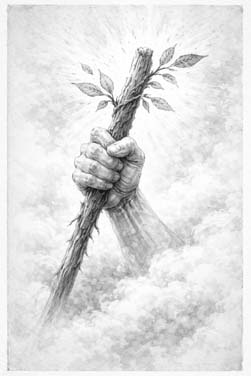
Wands × 1 = the creative drive in seed form. On the Ace of Wands, a hand emerges from a sleeve and holds a large wand pointing upwards. All the energy of the suit is gathered in this single gesture. In a spread, the card announces a fresh desire, an urge to create, a project asking to be born. It invites you to seize this energy while it is alive: one first step is enough to set it in motion.
The Two of Cups: the emotion that ripens
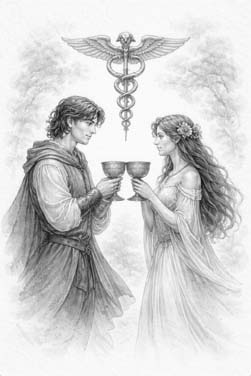
Cups × 2 = the emotion that gathers and waits. The Two of Cups shows two cups topped by a plant motif that links them. The Two is the number of preparation: feelings gather, the relationship takes shape inwardly. In a love spread, the card speaks of an encounter in the making or of a bond that first asks to be felt. It invites you to recognise what you feel, so you can share it at the right moment.
The Seven of Swords: thought in action
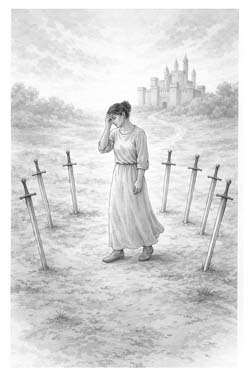
Swords × 7 = thought in action in the world. On the Seven of Swords, six curved blades surround a straight sword placed in the centre. The Seven is the number of action that radiates outwards: here, your ideas and your words act around you. The card describes a decision made, a speech that carries, a strategy put into practice. It invites you to say clearly what you think and to stand by your choices with confidence.
The Ten of Pentacles: a completed construction
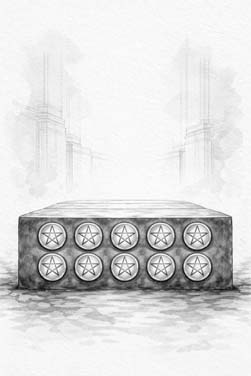
Pentacles × 10 = completion in the material world, and the passage. The Ten of Pentacles arranges ten flowered coins linked by stems. Here the suit reaches its fullness: assets built up, a piece of work carried through to the end, material security secured. The Ten also opens a new cycle. The card invites you to recognise what you have built, then to ask yourself what you want to build next, on this solid base.
Draw a spread with all 78 cards
How does the position in the spread change the reading?
The suit × number formula gives the heart of the card. The position gives it its direction. Take the Seven of Swords, “thought in action”, and place it in a past, present, future three-card spread.
| Position | Reading of the Seven of Swords |
|---|---|
| Past | A recent decision, words that moved the situation forward. |
| Present | The moment to speak up, to defend your point of view, to act with your head. |
| Future | A strategy taking shape, an idea about to find its application. |
In a cross spread, the same card in the Challenge position asks you to clarify your intentions; in the Advice position, it encourages you to express what you think. The card stays the same, and each place asks it a different question.
Three more guides help you read the minors across a whole spread:
- The dominant suit. Three Cups out of five cards show that your question plays out mainly on the emotional level, even when it concerns work.
- Repeated numbers. Two Nines in a spread signal a period of maturity and transition in the areas concerned.
- The balance between majors and minors. The major arcana mark the big stages of your life; the minors show the concrete steps within your reach this week.
And how do you read the sixteen court cards?
The court cards form the second family of the minor arcana. In each suit, the Page, the Knight, the Queen and the King represent four degrees of maturity of the same energy. The Page discovers, the Knight sets off on a mission, the Queen embodies the suit from within, the King masters it and puts it at the service of the world. A Queen of Cups thus speaks of someone fully attuned to their emotions, a Page of Pentacles of someone discovering the value of their resources.
Court cards are often read as people around you, or as facets of yourself. They complete the suit × number method: the suit keeps its area, and the court card replaces the number with a character. Our article on the sixteen court cards of the Tarot de Marseille presents them one by one.
Marseille or Rider-Waite minor arcana: how does the reading differ?
In the Rider-Waite deck, each numbered card tells a small story, which you read like a picture. In the Marseille deck, you read a structure: a suit, a number, a pattern. The two approaches shed light on the same card in two ways.
The Marseille reading gives you great freedom. Here the Seven of Swords speaks of thought in action, and your question specifies the nature of that action. This openness makes the method very flexible: the same grid adapts to a question about love, work or money. You can find the details of all 78 cards, majors and minors, in our guide to the tarot cards.
What the minor arcana bring you
The minor arcana give your spread the texture of everyday life. The majors show the big movements; the minors say where they play out and how you can act: a conversation to open, a budget to set, a desire to follow, an emotion to share.
With the suit × number method, you hold a simple key to the 40 numbered cards. Start with one card at a time: name its suit, name its number, put them together in one sentence, then relate it to your question. After a few spreads, the reading flows, and the minors take their place in your interpretations.
Would you like to try? Draw your cards from the full deck and read each minor arcana card with your new formula.
Frequently asked questions
How do you read the minor arcana of the Tarot de Marseille?
You combine three guides. The suit gives the area of life: Wands for desire and action, Cups for emotions, Swords for thought and speech, Pentacles for the body and the material world. The number, from Ace to Ten, gives the stage of the cycle. Finally, the position in the spread points the reading towards your question.
What do the minor arcana mean in the Tarot de Marseille?
The 56 minor arcana describe everyday life: your emotions, your projects, your decisions, your money and your body. The 40 numbered cards combine a suit and a number; the 16 court cards (Page, Knight, Queen, King) show four degrees of maturity in each suit. Together, they bring concrete detail to the reading of the major arcana.
Why do the Tarot de Marseille minor arcana show patterns instead of pictures?
The numbered cards of the Tarot de Marseille follow the tradition of old playing cards: they arrange the suit symbols in an ornamental pattern, with leaves and flowers. Illustrated scenes came later, with the Rider-Waite deck published in London in 1909. In the Marseille deck, you read the card through its suit, its number and its design.
Can you do a spread with only the major arcana?
Yes. The 22 major arcana are enough for a reading centred on the big dynamics of your life. The 56 minor arcana add concrete details and levers you can use right away. Many readers start with the majors, then bring in the minors once the suit × number method feels familiar.
What do the four suits of the Tarot de Marseille represent?
Wands represent desire, creativity and the drive to act. Cups represent emotions, love and inner life. Swords represent thought, speech and decisions. Pentacles represent the body, work, money and everything that is built in the material world.
Sources and further reading
- Alejandro Jodorowsky et Marianne Costa, La Voie du Tarot (Paris, Albin Michel, 2004)
- Jean Dodal, tarot de type Marseille (Lyon, début du XVIIIe siècle)
- Arthur Edward Waite, The Pictorial Key to the Tarot (Londres, Rider, 1910)
Want to try it on your own question?
The app interprets your own Tarot de Marseille spread, card by card, based on the question you ask.
Get a free reading1st reading free · then tokens from €4.99, pay as you go